
The Mandalorian and Grogu’ Is Not the Star Wars Movie We Need Right Now | Review

What Is ‘The Mandalorian and Grogu’ About?
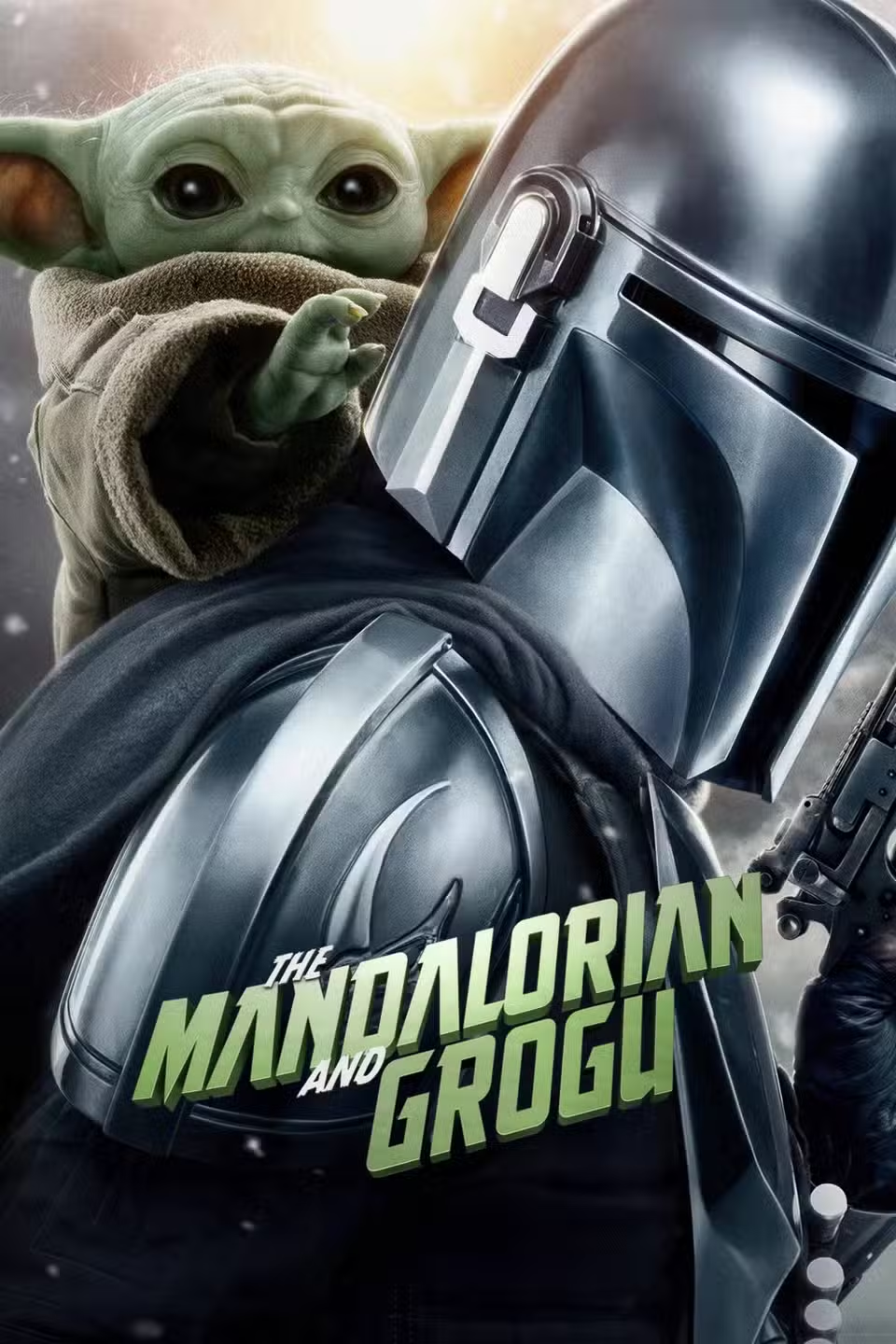
The Mandalorian and Grogu picks up after Season 3 of the Disney+ series, placing it chronologically after the fall of the Empire and between Return of the Jedi and The Force Awakens in the broader Star Wars timeline. Following his ongoing conflict with Moff Gideon (Giancarlo Esposito), Din Djarin now works alongside the New Republic, tracking down remaining Imperial war criminals with Grogu by his side as his adopted son.
A new assignment from New Republic Colonel Ward (Sigourney Weaver) soon pulls Mando into an uneasy alliance with the Hutt Cartel, who recruit him to locate the long-lost heir to Jabba the Hutt, Rotta (Jeremy Allen White).
Before getting too deep into the plot, the film opens on a genuinely strong note, featuring inventive and energetic action sequences. From a tense hallway battle seen through the perspective of a mouse droid to a striking one-take sequence of Mando cutting through snowtroopers, the opening feels closer to a John Wick-style action film than traditional Star Wars. Ludwig Göransson’s score also stands out, given plenty of room to elevate the intensity of these moments.
However, despite the strong start, the opening ultimately lacks meaningful narrative weight or compelling dialogue—an issue that becomes increasingly apparent as the film progresses.
As a whole, The Mandalorian and Grogu is built on one of the most stripped-down screenplays in the history of Star Wars. There’s little subtext, no real thematic backbone, and almost no character development. The story largely functions as a sequence of missions: characters send Mando to a location, retrieve a MacGuffin, and repeat the process without much narrative evolution.
Even the dialogue, while not outright awkward in the way infamous lines like “I don’t like sand” or “Somehow Palpatine returned” are remembered, remains flat and purely functional. It serves mainly to deliver exposition rather than build character or relationships. As a result, there are very few moments where characters feel like they’re truly connecting, leaving Din Djarin oddly detached from nearly everyone around him—even Grogu.
Grogu and Embo are the Scene Stealers of ‘The Mandalorian and Grogu’
Din Djarin feels more one-dimensional here than at any point in the Star Wars franchise, though Grogu thankfully fares somewhat better. Many of the film’s most effective moments come simply from Grogu being effortlessly adorable, and it’s difficult not to smile during his interactions with the Anzellans. However, even he isn’t entirely immune to the film’s shortcomings. The combination of an uninvolving story and flat dialogue makes the 2-hour-and-12-minute runtime feel surprisingly sluggish, with even certain Grogu-centric sequences overstaying their welcome.
The supporting cast is equally uneven. Jeremy Allen White’s Rotta the Hutt is given a surprisingly substantial amount of screen time, offering a refreshing look at Hutt character dynamics. In contrast, both Colonel Ward and Star Wars Rebels fan-favorite Zeb (Steve Blum) are noticeably underutilized, despite their potential. Sigourney Weaver’s presence in her Star Wars debut also feels underwhelming, with the script giving her far too little material to work with.
One of the few characters who does leave an impression is Star Wars: The Clone Wars standout Embo, who provides a welcome physical and tactical challenge for Mando whenever he appears.
Outside of Embo, however, the film’s biggest weakness lies in its villains. The Hutt Twins and the Imperial officers Mando is pursuing are largely forgettable, lacking both personality and presence. This is especially disappointing for a franchise historically known for producing some of cinema’s most iconic antagonists.
‘The Mandalorian and Grogu’ Feels Like a Step Backwards for the Star Wars Franchise
The Mandalorian and Grogu feels like a return to form for the Star Wars brand—but only in the same way Star Wars: The Clone Wars (2008) did. That film also played more like a condensed arc of television episodes than a fully realized cinematic experience, and the same issue applies here. The pacing, structure, and dialogue are all strictly by the numbers, leaving little room for the charm, wonder, or cinematic spark that has traditionally defined the franchise.
A forgettable Star Wars film is one thing, but a film that arguably undermines a once-compelling character is another entirely. Since The Book of Boba Fett, Din Djarin’s character progression has largely been reversed or reset. His separation from Grogu for Jedi training under Luke Skywalker (Mark Hamill)? Short-lived. The loss of the Razor Crest? Replaced. Wielding the Darksaber? Quickly relinquished to Bo-Katan (Katee Sackhoff). The Mandalorian and Grogu continues that pattern, reinforcing the sense that Lucasfilm is uncertain about the long-term direction of the character.
That said, the film is not without merit. Is it the worst Star Wars movie ever made? Far from it—there is still entertainment value to be found. Is it among the franchise’s best? Also no, as it may ultimately stand as one of its most forgettable and least consequential entries.
Projects like Andor, Maul: Shadow Lord, The Acolyte, Visions, and especially the early seasons of The Mandalorian itself demonstrate how expansive and ambitious Star Wars can be beyond straightforward action and spectacle. At its best, the franchise can deliver something truly unforgettable—even when individual entries are imperfect. The Mandalorian and Grogu, however, settles into a middle ground that is neither disastrous nor inspired, and it is precisely that mediocrity that makes it one of the most frustrating entries in a galaxy far, far away.
The Mandalorian and Grogu debuts in theaters on Friday, May 22, 2026.

Discover more from O2MOVIE
Subscribe to get the latest posts sent to your email.